Showing posts with label Perugia. Show all posts

Saturday, January 9, 2010

La Festa dell'Epifania


This year
we were lucky to arrive in Italy early enough to enjoy the celebration of the Feast of the
Epiphany commemorating the visit of the three Iranian astrologers (i Magi) to the baby Jesus. In Perugia, the celebration included a children’s party honoring La Befana, a costumed procession through the historic center of Perugia, and a free concert by a local community orchestra. La Befana is an old crone who, it is reputed, visits children on the eve of the Epiphany (5 January) to leave gifts of candy for “good” children and coal for misbehaved kids. The legend of Befana, which is an Italian original, is that the Magi stopped at her hut to ask directions to Bethlehem to visit the newborn king. Befana, always busy with sweeping and baking, could not help them, but after they had left she regrets that she hadn’t joined them. So she packs her bag with goodies and her broom and sets out to find il Bambino. (Part of the legend is that she had lost her only child and looks for the newborn to alleviate her grief.) She never does find him, and so she continues her quest to this day, visiting homes wherever there are children and leaving gifts and sweeping the floor. Interestingly, a Perugian street sweeper had attached a Befana doll to his little 3-wheeled Piaggio – no doubt a tribute to the patroness of sweepers. See the pictures. The procession portraying the Magi assembled in the Piazza d’Italia and I was able to get a photo of a double-humped camel – the real star of the parade -- and his handler.

We brought you peace!


As they proceeded down the Corso Vannucci, I took a video showing the Magi and other fantastic characters, including a black prince sitting high atop the camel looking impossibly dignified. As if all this weren’t amazing enough, the musicians played – of all things – an Israeli folk song “Havenu shalom aleichem” (We brought you peace).

Amazing Chops!


After the procession, there was a free concert, in the beautiful Sala dei Notari (the old City Council chamber in the 13th Century Palazzo dei Priori) by a local community orchestra, La Filarmonica Pretola, with a surprisingly eclectic selection of tunes ranging from Harold Arlen to Giuseppe Verdi. The band – all wind instruments plus percussion -- played well enough, but for me the highlight was the improvising lead trumpeter in "Over the Rainbow" (Sopra il Arcobaleno) who had amazing chops despite his advanced years – see the video.

Tuesday, January 5, 2010

Returning to Perugia

Waiting for gli studenti

The Franciscan Heritage Semester Study Abroad Program (FHP) 2010 is scheduled to resume in a few days with the arrival of our intrepid cohort of St. Bonaventure students: Evan Comins, Amie Marasco, Kara Telfer, Abby Schaaf and Ryan O’Donnell. Kara and Abby are education majors who are taking advantage of the special opportunities that FHP offers. They will be taking courses that have been approved for education majors, including Developmental Psychology, language and Clare College courses. In addition, Kara and Abby will be interning at the Perugia Montesorri school. Evan and Amie will be completing a series of courses that will virtually complete the requirements for an International Business minor. Their course schedule will include several business courses that focus on European and global business practices, including the politics and economics of the European Union, and, of course, they will study Italian. Their semester will be topped off by a month long internship with the Costa D’Oro Olive Oil Company in nearby Spoleto. And Ryan is enrolled in the “full immersion” Italian language and culture program. This is a unique program in which students attend Perugia’s Universita per Stranieri (University for Foreigners) studying Italian while their progress is monitored by the Umbra Institute, which awards credits transferable to American universities.

(Above: That's Mrs. C on Corso Vanucci, still decorated for Christmas. Right below: Ryan enjoys the first of many pizzas at the Cafe di Perugia.)

Ryan is already here (his program starts a few days earlier) and the other students will arrive soon. I thought that this might be a good time to resume blogging. Before the program starts in earnest I thought it would be a good opportunity to update our activities since last year.

Last summer, Mrs. C and I visited three of our AFCU (Association of Franciscan Colleges and Universities) partner campuses, Hilbert College, Neumann University and Felician College, greeting old friends and making some new ones for the program. We are looking forward to their participation, hopefully for spring, 2011. We’ll be attending the AFCU Symposium this summer at USF Fort Wayne, IN, and will encourage wider participation by AFCU schools. To date, we have enrolled students from Alvernia, Neumann, USF Ft. Wayne, Marian, as well as SBU.


Spring 2009 highlights


(From left to right: Senora Traub waiting for the bus to Todi;
Mrs. C leads Umbra Seder; Gerry Straub leads Assisi retreat; clockwise: Gilberto Zapitello, Tim Noone, Judy C., Colleen Noone climbing Mt. Subasio; Jacques Dalarun overlooking the Spoleto Valley, Mt. Subasio and Assisi.)


To review some of the highlights of last year’s program: We were happy to host, Dr. Maria Traub, of Neumann University, whose course, “Saints and Relics” integrated field trips to the sites of saints whose relics are found throughout Italy, with many Franciscan saints in Umbria. In January, we welcomed the internationally renowned Franciscan scholar, Jacque Dalarun, who gave a fascinating presentation illustrating his paleographic and interpretive skills on the famous autograph letter of Francis to Leo (which we were later to view in the Duomo in Spoleto.) Later in the semester, we hosted a Passover Seder, led by Mrs. C, and attended by students of various faiths. We organized a lenten retreat at Casa Papa Giovanni, in Assisi, lead by the well-known Franciscan film maker Gerry Straub, and attended by Tim Noone (yes, another famous scholar) and his wife, Colleen, and the Italian philosopher Gilberto Zapitello. Of course, we also took students on field trips to Assisi, Montecasale, and La Verna in conjunction with my course on “Contemporary Global Issues: The Franciscan World View.” We look forward to resuming many of these special events, and an expanded range of courses and visitors with more students participating in 2011.


Mrs. C’s famous melanzane parmigiana

Back in the US this fall, we sponsored the visit of Tom Cornell of the Catholic Worker Movement, Pax Christi, and the Catholic Peace Fellowship Tom is credited with organizing the very first anti-Viet Nam war demonstration in 1963, and the first corporate act of resistance to the Viet Nam War, the burning of draft cards, in 1965. (See picture on the left from NYTimes, 1965.) We first met Tom in Assisi in March, 2008, where he led a conference on the issue of conscientious objector status for Catholic GIs. He was returning from an audience with Pope Benedict regarding the CO question, and was accompanied by a former Abu Ghraib interrogator, Joshua Casteel, who had recently won a CO discharge as a Catholic pacifist. While at SBU, Tom visited several classes, lectured to the University Forum, and visited the Olean cabin where Thomas Merton summered with Robert Lax. (See photo on the right for Tom in Lax's cabin.)

Finally, no update would be complete if I didn’t mention the visit to SBU of several of my students from the previous spring: Nikki Tarantula and Ashlee Serik, from Neumann, and Patrick Craven from Elon U. They were visiting their Bonaventure friends Phil Penepent and Noel Baylor. Patrick also had a more "serious" purpose: he had decided to write his senior thesis on "Franciscan Theology of Creation and Community Supported Agriculture," and so I was happy to bring him to Mt. Irenaeus and Canticle Farm to interview Franciscan brothers and sisters whose ministries embodied the spirit of Francis and nature. (See photo above of Patrick at Canticle Farm with Sister Joyce Ramage, Farmer Mark Printz, and unnamed dog.)

Of course, we could not let the leave western New York without a fine dinner of Mrs. C's famous melanzane parmigiana (eggplant parmesan) !!!!

(Above is a picture of -- clockwise -- Ashlee, Nikki, the C's, Phil, Noel and Patrick. Notice the clean plates and the conspicuous bottle of Costa D'oro's Il Grezzo on the table.)

Next: The Magi visit Perugia

Monday, February 9, 2009

Supper at San Isidoro, Sambuca at the Pantheon, Fog in Assisi, Chinese Food in Perugia


One of the immediate benefits of our senza cane status was our ability to take an overnight to Rome to have dinner and drinks with some old friends: Tim Noone, Jacques Dalarun and Marybeth Ingham at Collegio San Isidoro, which is the Franciscan House for the Province of Ireland, replete with a chapel decorated by Bernini and a tradition that goes back to the great Franciscan scholar, Luke Wadding. (See picture.) Although, according to Jacques, Napolean once used the chapel to stable horses. I have a special debt to the friars of San Isidoro. Here's the story:

In the mid-19th century, Bishop Timon of Buffalo, went to Rome for the official Proclamation of the Dogma of the Immaculate Conception. While he was there, he asked the Minister General of the Franciscans to send some missionaries to the Buffalo area to work with the Irish immigrants who were building the Erie Canal. Timon was referred to San Isodoro where he met one of the professors, an Italian named Father Panfilo from the town of Magliano, in the Abruzzi region. He spoke English fluently and was convinced to come to the Buffalo diocese to minister to English speaking workers. In June of 1855, four Franciscans arrived in New York and made their way to Buffalo, where they established parishes and schools including Saint Bonaventure University.

The next picture shows Tim, Jacques, Judy and me.

After dinner, Tim, Jacques, Judy and I went out for café e sambuca at an outdoor café with the Pantheon a few steps (quattro passi) away. This is NOT the usual fish-fry that one does on a Friday night in Franklinville.

The next day we returned to Umbria, but stopped in Assisi first. There we joined a group from the Umbra Institute. Assisi was shrouded in fog that day, but I snapped a couple of pictures. Perhaps the most bizarre is an installation, a Nativity scene, in the Piazza Inferiore di San Francesco by Kurt Laurenz Metzler, called "Neurotic Metropolitan Nativity" described in the local press as an invitation to dialogue and hope."
Judge for yourself.


I've also added a very unusual, totally random,
presentation of the image of Francis.

The next day we took our students to La grande Shanghai,
a Chinese restaurant near the Stranieri. I know,you're asking: why go to a Chinese restaurant in Italy? Well it is pretty cheap (I paid the tab) and the kids loved it Here’s a picture:


Clockwise: Judy, Carla, Samantha, Angela,
Sarah, Noel, Mike, Phil and Senora Traub.

Perugia observes the World. The World observes Perugia

The semester here begins with an orientation meeting in the beautiful, Sala de Notari, in the Palazzo dei Priori. As we departed the session we were greeted by a raucous but non violent protest demonstration for peace in Palestine. (Our American students are always surprised to find the incredible ethnic and racial diversity and the relative absence of spoken English here.) Many of the marchers carried the now familiar rainbow “PACE” flags, one or two Italian flags, and many flags of Palestine. The signs and chants were not so much for peace, but against the US and Israel. I’ve inserted a little movie just to give you an idea of what we saw.


The rest of the world usually pays little attention to Perugia, but over the last year or so, a lot of negative publicity has been generated by “il delitto de Perugia” the awful murder of an English student at the Stranieri for which 3 young people, a young female student from Seattle, her Italian regazzo from Puglia, and an African immigrant, are now on trial. You can tell when court is in session by the panoply of satellite dish trucks filling the via Baglione outside the Perugian courthouse. I’ve pasted a picture of this scene as well. Here an anchor guy is trying to figure out what to say. The Italian and English media cover the smallest detail, even what Beatle song Amanda sings and plays on her guitar. (You can imagine this one yourself -- I don't think I want to go there.) Speaking of "going there" 0ur friend Laura, an Italian lawyer, had offered to get us into the trial -- they have an English translator -- but we were scheduled to go to Assisi that day. The choices don't get much more dissimilar than that!

Siamo qui ancora! (Here we are again!)

Here we are again in Perugia for another semester of the Franciscan Heritage Program. We’re back on Paradise Street, la via de Paradiso, but this time we had to leave Dodger back in the US. So we are senza cane! Besides saving a lot of money and customs hassles, we are now considerably freer to enjoy our leisure time in Italy. Although we are far from home I have not lost my addiction to news, especially political news. And the two big items here have been the war in Gaza and the impending inauguration of Obama. We'll get into that later; first the basics.
Perugia is a very small city perched upon a saddle-back hill-top overlooking the Spoleto Valley built millennia ago by Etruscans. The Etruscans built a huge wall around the original city, much of which still stands. Another wall was built, I believe in the middle ages a few hundred meters beyond the original one. Our home is below the Etruscan wall, but inside the medieval wall, beyond which is a unremarkable modern Italian city. Our apartment is in a 1,000 year old building from which troops once guarded two of the gates of the medieval wall. In the next picture, you can see our little apartment as viewed through the Porta Eburnea, in the outer medieval wall. Look up the street and you'll see a yellow wall.

Look closely, that's me inside the window blogging away

But although old, walled and relatively remote, Perugia is surprisingly in touch with the rest of the world. This is probably due to the presence of the Universita per Stanieri (The university for foreigners) to which students come from all over the world in order to study the beautiful lingua italiana. And many never leave.

Wednesday, August 27, 2008

John's Fantastic Video!

This blog has suffered neglect over the past few months. I was hoping to have some final reflections regarding this past year's program -- and I promise that I will soon. I want to report on some of my observations regarding Assisi particularly. But now I am back at work preparing for next year's (Spring 2009) Franciscan Heritage Program.

The catch-up posting will have to wait: for now, I want to post this fantastic video regarding the experiences of the SBU students who did internships in May. The internships included placements at Costa D'Oro, an olive oil exporter in Spoleto, where students did market research and web editing, and working directly with John Burke's firm Talent-and-Energy. John is an alumnus of SBU who has been working to place and expand opportunities for our students in Italy. He put this film together from snippets of digital video taken during his work with the students in Perugia last May. John had a way of pointing his little camera at you and asking you to "say a few words" about the program, or "say a few words in Italiano!" The results is this fantastic video below. I hope you enjoy it -- maybe next year you'll have a supporting role in the next FHP video.


Tuesday, April 15, 2008

Marzo é Pazzo or March Madness

As we planned for mid-semester break in early March we agonized over where, when, and how to go. We had long planned to go to Barcelona. I had a fantasy of renting a car and driving along the Mediterranean coast visiting the Cinque Terra, Genova, Nice and the French Riviera at the western end and then through Provence to Barcelona. It sounds pretty good, but the prospect of so much driving, especially the return trip, was too much. So we decided to break up the week: We flew to Barcelona for a few days of fantastic weather and flew back to Italy for a return to cold and dreary rain. But I’m getting ahead of myself.

“Where ya goin’? Barcelona!”

Barcelona is a beautiful city, as everyone knows, with wide streets and late nights, where people speak Catalan (Hola!) and eat tapas (Patatas bravas!) The trip was great. Here are the highlights: We walked down the Ramblas – big wide avenues with a center mall filled with stalls, buskers and people -- to the coast and back up to the Picasso Museum. On the way we passed a bunch of guys doing Capoeira -- a 16th century combination of martial arts, breakdancing and acrobatics from Brazil. See for yourself.

..........................................


Picasso spent his student years in Barcelona, and this Museum included a lot of early stuff that you might not associate with his
more famous later work. Among these early works, was a painting called “Ciència I caritat” or Science and Charity. It was his second exhibited work (1897), and won several awards, but it doesn’t look like anything you’d associate with the later work of Picasso.


(S T.) A N T O N I O G A U D I

The architecture of Antoni Gaudi is all over Barcelona and there is nothing anywhere to compare with it. This is a guy who hated straight lines and right angles. We spent a day tracking down all the Gaudi we could find: several apartment buildings, a private park and his unfinished cathedral, La Sagrada Familia.
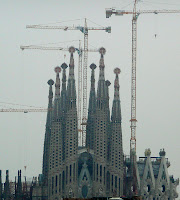
(shown on the left)
I don’t know too much about Gaudi: I hear he was a religious and political fanatic, but I don’t know if that’s good or bad. He supported autonomy for Catalonia and sought a revival of traditional Catholicism.

I do know that despite the incredible work he left behind, he died poor and unknown. Run over by a street car in 1927, he was taken to a pauper’s hospital. By the time someone finally recognized him, it was already too late and he died three days later, and was buried beneath the Sagrada Familia. The good news is that in 2003, Gaudi was proposed for sainthood, and today the Gaudi Beatification Society comprises 80,000 people worldwide who pray to Gaudi and beseech him to perform miracles.


Another interesting thing I learned was that Gaudi had intended to build a skyscraper “The Attraction Hotel” in New York City, way downtown where the World Trade Center was eventually built. In fact a group of architects resurrected his drawings and proposed it for the rebuilding ground zero!


Queen Judy and the Fabulous Taiwanese Girls! (and the Flamenco King)!!

But no tour of Gaudi’s Barcelona would be complete without a visit to the park he designed for Count Eusebi Güell. Parco Guell is a hillside in a remote section of Barcelona. And it was here that we met the fabulous and delightful Taiwanese girls, Joyce, Zuan and Yi-Shan. The girls took Judy by the arm so that she wouldn’t fall as we climbed up and down the challenging terrain, dubbing her “Queen Judy.”
As if this weren’t enough,we were treated to a display of Flamenco street dancing as we left the park.
I posted a little movie of his act. The girls called it "Flamingo dancing."


G I R O N A
We went to a small town about an hour north of Bacelona, named Girona. Our purpose in going was not only that we heard it was a beautiful town with the best Catalan food in the area, but also that there was a Museum of Jewish History there. It turned out to be a fascinating place. There had been a small but very active Jewish community here but all signs of it had disappeared after the Inquisition. The actual physical relics were discovered about 100 years ago. Among the relics were depositions by the leading Rabbi, Nachmanides, who debated with a leading apostate Jew, Pablo Christiani in the Disputation of Barcelona, 1263. The question put forth was whether the the Messiah had already come. But Nachman asked, if the Messiah has come, then why are humans constantly at war? Good question! We purchased a transcript of his testimony. (Nachman was banished for publishing the transcript and spent his last years helping to rebuild Jerusalem.) The museum was great, but greater still (my opinion) was the seafood paella and Catalan wine we had for lunch.

Towards the end of our stay the weather turned cold and wet. The town filled with crazy soccer fans from Glasgow drinking and singing. This was followed by busloads of very intimidating Barcelona police. I heard somewhere about soccer violence, but we left just in time. Barca won the game!

Yes we can – Liguria!

We returned from Barcelona with a few days left on our break and no dog to keep us home bound. The weather was lousy –rainy and chilly. We had planned to visit Cinque Terra – but that’s no fun in the rain. It’s mostly a place of spectacular landscapes and hiking trails. But could we find another place to spend a couple of rainy days? Yes we can! We hopped a train for Genova (Genoa).

I found Genova to be a very strange place. It was architecturally and artistically unlike other Italian cities. More neoclassical ? It’s a port city and we stayed at a hotel near the waterfront. Everywhere were dark and narrow alleys. We found a great cheap restaurant, where the used tablecloths were thrown into a pile in the corner of the dining room. The food was excellent of course, but the atmosphere was straight out of a pirate flick!

Genova has the feel of a city trying to revitalize itself -- we know about that sort of thing.
But I should say, to be fair, that away from the port we found a high level of culture, although long past, including a street of old palazzos filled with wonderful art and a university (a relative newcomer having been founded in 1471.)

The University of Genova was just down the street, and of course, I had to check it out. We entered the very impressive courtyard of the very impressive university library

Here I found a wall plastered with posters for an upcoming student election. Check out old Vigo … who sports a CBGB T shirt, goatee and “yes we can!” (We’ll talk politics in a later blog.) One final highlight of the visit to Genova was the plaque on the wall marking the birthplace of Gottfredo Mameli, patriot-poet of Italy’s Risorgimento and, of course, lyricist for the Italian national anthem, Inno di Mameli (The Hymn of Mameli).

Torna a Cinque Terra!

We ended our March Madness at the truly magnificant Cinque Terra. Here on the coast below Genova we find five little towns accessible by trails and a little railroad. We could see much -- the weather was a little chilly -- but what we did see made us resolve to return. Here a statue Francis and the wolf of Gubbio overlooking the mediteranean! (Notice the little settlement clinging to the hillside.) And my favorite, a two dimensional modern sculpture along the "lovers' walk."