Wednesday, March 9, 2016

Thursday, February 25, 2016
Marco Polo, Turandot and China Night at the Stranieri
China Night at the Stranieri.
 |
| The Stranieri |
One of the enormous benefits
of life in Perugia is the diversity of the student population. My class at L’Universita per Stranieri has
students from Belgium, Sweden, Greece, Spain, Portugal, Israel, Holland, Turkey,
Palestine, Senegal, Korea, Libya, one guy from Canada and two guys including me
from USA. And Italian is the lingua
franca of our class.
 |
| my class |
. . .
 |
| Marco Polo? |
I’m sure you a familiar with Marco Polo, the famous 13th Century merchant-explorer who visited and stayed at the court of Kubla Khan, and whose account of the many wonders (pasta?) he found in this relatively advanced civilization was widely published to a skeptical yet curious Europe. Later it inspired Cristoforo Columbo, claimed by Italians as a native son, but possibly a Catalan converso Ebraio.

“Turandot” is set in medieval China with its popular aria, Nessun Dorma, sung by Prince Calaf who awaits his fate as he courts the icy Princess Turandot, Interestingly, the opera, with its characters Ping, Pang and Pong, was banned in China for 72 years after its 1926 premiere in Milan.
After an hour of the usual series of long-winded speeches by everyone from il magnico Rettore of the Stanieri to the Perugia chief of police, the concert began. I’ve posted a few videos: two of the chorus: “Va pensiero, https:www.youtube.com/watch?v=y5uyDBSlijU the chorus
of the Hebrew slaves from Verdi’s opera, Nabuco, and another number from
China called the “Bed of Chrysanthemum flowers.” https://youtu.be/ZKBbnuJWUM0 The third, by a remarkable pair of students,
is an American pop song “Perfect” by the“boy
band” One Direction. https://youtu.be/7HiguvSvhJc There were
several other knock-out numbers, particularly “Non piu andrai, Farfallone” from Rossini’s Barber of Seville sung
by student Geng Zihao in a booming baritone
voice. I couldn’t get a video, oto.
 |
| Geng Zihao |
The evening was unlike
anything I’d ever seen. I gave “Bravos”
to some of the students after the show and
now I enjoy their courteous greetings when I see them around town. Like so many of the foreign students at the
Stranieri, I’ve come to love these kids, their openness, and passion for Iphones
and learning!
Saturday, February 6, 2016
FOR JUDY
Traveling with a Ghost
This is my first time back in Perugia since my beloved Judy died last summer. We had been coming every January for nearly ten years, but our last visit was cut short by her swiftly deteriorating health. Ever since, I have felt almost a duty to return and complete our trip.
 I recall one time a woman from
Judy's aerobics class ran out of a shop when she saw us pass by soon after arriving. "Buon tornato! E 'certamente gennaio perché qui è di nuovo Judy!" (Welcome back. It must be January because here is Judy again!) Now I must explain several time each day why I am alone: "Mi despiace ma mia moglie ha morta" (I am sorry but my wife has died." And as I walk the dark lonely medieval streets of this ancient city every stone is haunted. So I'm not really alone; I'm traveling with a beautiful ghost.

Ten years ago Judy and I enrolled in the Universita per Stranieri (University for Foreigners) to learn "un po' Italiano" -- very little, but we had a ball distracting each other and making friends. So I enrolled for the next course "advanced beginner" this year. This has been more painful than I expected but I still believe it's necessary to look my grief in the face with courage; that was Judy's final gift to me. And I do believe it's already getting better ...
. . . with a lot of help from my friends
We developed a nice tradition over the years: On our last night in Perugia, we would to eat one last pizza al zucco at Al Mangiar Bene, then "faremo una bella passiagata" (take a beautiful walk) circumventing the 3,000 year old Etruscan wall that surrounds the historic center, and finally stopping one last time to buy two Baci at "Sweet sweet way" for our nightly dolci. Well, I nearly lost it when I saw that chocolate shop the other day --
I think I will stay away for more reasons as well
| "Wally" |

Everyone has been so kind to me this week and I have already had more fun than this post would have you think. I do have many fun tales to tell in this blog. Stay with me, it's getting better!
Wednesday, February 16, 2011
Back on the beat with my panel of experts
This blog has been relatively inactive since our last sojourn in Italy. Much of my light comments have been reserved for Facebook. But I thought this might be a good place to record my observations and opinion as an American in Italy. Although I don’t speak the language very well, I do try to read the local papers and La Repubblica at least once a week.
And, of course, I have a small circle of local Italian friends to whom I turn for information: Fausto, my barber, Fabrizio, the laundry guy, and my buddy Valter, slow food impressario, sommelier and olive oil taster. I almost always misunderstand the news- papers, so I rely on Valter for precision. None of them can speak English, except Valter, who studies and tries hard.
Next posting: Did Bob Dylan write a hymn to Silvio Berlusconi?
 |
| Fabrizio |
 |
| Wally |
 |
| Fausto |
Next posting: Did Bob Dylan write a hymn to Silvio Berlusconi?
Silvio Berlusconi jams with Bob Dylan!
 |
| Left to Right: Dr. John, Sandro Bondi, Joni Mitchell, Neil Young, Rick Danko, Silvio Berlusconi, and Robbie Robertson |
Silvio, silver and gold
won't buy back the beat of a heart grown cold.
Silvio, I gotta go
Gonna find out something only dead men know.
won't buy back the beat of a heart grown cold.
Silvio, I gotta go
Gonna find out something only dead men know.
-- Bob Dylan, Silvio
No, this is not a real photo, but a slanderous photoshop attempt to link Bob and the psico nano. The picture is actually from Martin Scorsese's film of the Band's farewell concert Last Waltz. Sandro Bondi's face is superimposed on Neil Diamond's body -- hence the cheesy outfit -- and Silvio's face replaces Van Morrison. Bondi is the former Communist mayor of Fivizzano, who sucked up to Silvio and was appointed Minister of Culture. "Sporca Communista!" says Fabrizio. Actually, Sandro did not fare well with the Communists who called him "un rapanello" or radish: that is, red on the outside but white on the inside.
Io non capisco la bunga, bunga. (I don't understand bunga, bunga)
The big story here since we arrived is another scandal by the allegedly depraved Prime Minister of Italy, Silvio Berlusconi. The scandal, referred in the press as “il caso Ruby” features a 17 year old Moroccan exotic dancer with the show name, Ruby Rubacuore (her name is translated "heart stealer" but Fausto calls her Ruby Rubasoldi, or money stealer) who allegedly participated in “bunga bunga “ parties with Silvio and his buddies (who include Putin and Kaddafi) with underage prostitutes, and lots of drugs. (La Repubblica reports cocaine; Fausto adds “e multo Viagra!”)

Bear in mind, this is a man who has been indicted at least 12 times. He’s always been able to beat the rap, and when not, was able to change the law and legislate his immunity.
You hear a lot of cynical young people refer to their society and its government as a “gerontacracy.” It’s hard to dispute this: Berlusconi, the Prime Minister is 74+, and the President of the Italian Senate, Napolitano is 90. I like Berlusconi’s full title: il Presidente del Consiglio dei Ministri della Repubblica Italiana, although he's often referred to by his nickname. Il Cavaliere. I asked Valter to compile a list of nicknames. Here's what he sent me (untranslated):
Ecco i soprannomi di Silvio Berlusconi più divertenti :
- Burlesquoni: in omaggio alla sua goliardia
- Cavaliere Mascarato: perché l'immagine è la prima cosa per lui (copy: Striscia la Notizia)
- Sua Emittenza: a causa di Mediaset
- Bellachioma (copy: Marco Travaglio)
- Testa d'Asfalto (copy: Beppe Grillo)
- Psiconano (copy: Beppe Grillo)
- Er Catrame, sempre per la capigliatura immobile frutto del celeberrimo trapianto
- Nanefrottolo, per chi vuol mettere in dubbio la sua credibilità
- Al Tappone, da quando s'è messo in testa il panama bianco. Il riferimento ad Al Capone è chiarissimo (copy: Marco Travaglio)
- Il Caimano, dal celebre film di Nanni Moretti
- Il Cainano, parodia della pellicola di cui sopra
- Bandanano, riferito a quando ricevette Tony Blair e moglie, in Sardegna, con in testa una bandana bianca
- Silviolo
- Burlesquoni: in omaggio alla sua goliardia
- Cavaliere Mascarato: perché l'immagine è la prima cosa per lui (copy: Striscia la Notizia)
- Sua Emittenza: a causa di Mediaset
- Bellachioma (copy: Marco Travaglio)
- Testa d'Asfalto (copy: Beppe Grillo)
- Psiconano (copy: Beppe Grillo)
- Er Catrame, sempre per la capigliatura immobile frutto del celeberrimo trapianto
- Nanefrottolo, per chi vuol mettere in dubbio la sua credibilità
- Al Tappone, da quando s'è messo in testa il panama bianco. Il riferimento ad Al Capone è chiarissimo (copy: Marco Travaglio)
- Il Caimano, dal celebre film di Nanni Moretti
- Il Cainano, parodia della pellicola di cui sopra
- Bandanano, riferito a quando ricevette Tony Blair e moglie, in Sardegna, con in testa una bandana bianca
- Silviolo
 | ||
| A little nip, a little tuck, and molto hair plugs - before and after. |
Berlusconi owns most private TV stations and, of course, can influence the public ones. In addition, he owns newspapers, magazines, and Mondadori, Italy’s largest publishing house. Over the past several decades, he has managed, thereby to shape the popular culture, especially its portrayal of women, replicating his predelictions on a grand cultural scale. For a serious account of psiconano's influence, see Barbie Nadeau's perceptive article "Bunga Bunga Nation".


The current scandal is celebrated by an inane pop songby a weird, but musically respected, group known as “Elio e le storie tese” (Elio and the tense stories) whose brand of “dementia rock” is influenced by Frank Zappa and the dada pranks of the situationist artists. The song itself is both a comment on Berlusconi’s behavior and I’ve learned a parody of a song called “Waka, Waka” by Shakira. (How do you parody a song called “Waka, Waka”? )
Next few posts: So what?
Why bunga bunga is NOT funny
Why Berlusconi?
To most Italians, Berlusconi’s antics are old hat, although even the Vatican, which has generally accommodated Il Cavaliere’s politics, has expressed concern with his morality. And on TV, Silvio gave a forceful defense claiming that it would offend his dignity to pay for sex. Even Ruby, who has admitted that “Daddy” has paid for an apartment, clothes, jewelry and spending money, claims that he is the first man who hasn’t asked for sex.
 I've been having fun with Silvio B in the last few entries, but I want to be clear that I consider myself a guest in Italy AND I love Italy. So this mess saddens me. I am
often asked why Italians put up with their scandalous PM, and frankly I don't know. There are two theories: (1) they like him and his style of living, and (2) they don't see an alternative. Both of these answers are depressing to be sure, and seem to point to something in Italians that Americans cannot understand. There is a sense of pessimism, or cynicism, that I often hear expressed and it leads to a kind of resignation. You see it in the smallest things: the ubiquitous cigarette smoke on the street, the incessant line jumping, the petty littering, the unfixed washing machine, and the unreturned call. Maybe this "caso Ruby" thing will shake things up a bit? Sadly, I doubt it. After all, when a third of the Italian legislators were indicted in the early 1990s, it was Berlusconi to whom Italy turned. One of the more benign stereotypes of Americans is that of the slightly goofy naive optimist. And not all Italians shrug their shoulders at the latest scandal. There are at least two groups who are affected by the misbehavior of il cavaliere: women, above all, and workers. I'll start with the latter.
 The real issue, as Fabrizio, Fausto and Valter will explain is that while their leader was having sex and drug parties at one of this three villas, he was neglecting his duty to secure the welfare of the people and the rights of workers. Italy takes the rights of workers seriously, the right to organize, to bargain collectively, and to strike (scioperere) are enshrined in their post-Fascist Constitution. Some believe these rights are too freely exercised, particularly the last one. Strikes here are announced well in advance and one plans travel, for example, around scheduled train strikes etc. And among the most historic site of labor history is certainly FIAT’s Mirafiori plant in Torino.
  Italy's growth rate, I'm told, is a mere 1% and traditionally protectionist Italy is now facing a growing encounter with globalization (globalizzazione). I don’t understand the story completely, but the new FIAT management, led by CEO Sergio Marchionne (whom, Valter complained was hugged by Obama, when he visited Chrysler last year). Marchionne has offered to invest huge sums to retool Mirafiori as part of a plan to produce Jeeps in Italy, but insisted on some “give-backs” from the union. The terms didn’t strike me as too draconion: limits on break times, additional guaranteed overtime,
  and promises to limit striking. FIAT had already negotiated a deal with workers at its plant in the job- scarce south, and recently a referendum was to be held in the more militant north. As it turned out, the workers voted to approve the deal, although the balance was achieved with the support of FIAT's white collar employees. However, one of the unions, FIOM-CGIL, in the federation,which bargain together. rejected it. Marchionne decided he had his approval and moved to block the dissenting union from further organizing activity in its plant. This divide-and-conquer strategy is apparently unprecedented. Not only was the disenfranchisement of the leading leftist union a particular outrage, but more importantly, the idea of dealing with different plants instead of a national bargain was unprecedented. Moreover, there was already a national agreement in effect that had been previously negotiated. These national agreements are always negotiated with the government acting as mediator. Where was Berlusconi when the workers needed him? Partying, perhaps. Berlusconi declined to intervene, and anyway he had already shown his position when he declared FIAT “would be justified in pulling out of Italy” if the workers didn’t ratify the new accord.
 Is the US the Mexico of Italy?
But where would FIAT go if it pulled out of Italy? Quite possibly, according to Marchione, to the US. FIAT's outsourcing jobs to Poland and Serbia is one thing, but to the USA? Here we see how the process of globalizzione has made the US, Italy’s Mexico!
Women in Italy
I've already mentioned the sorry state of women in Italy. Recently, Berlusconi advised women that the path to success is to marry a rich man! I can't say how many women take this advice, but coupled with the fur coats and cigarettes, it sometimes feels like the 1950s here. Worst is the portrayal of women (and men) on Italian TV, which is almost totally controlled by the PM. Berlusconi built a media empire, in part by populating TV quiz shows and news with beautiful sexy young "veline" (literally, scraps of paper) being leered at by middle-aged men. I'm told that the selection of the annual "velina" on Striscia Noticia, a news parody on Berlusconi's Canale 5, is an event which young women eagerly follow and for which they vigorously compete.
Maybe I'm judging Italy by puritanical standards, or worse, maybe I am trying to score political points, but there are facts that should be considered seriously. Italy ranks extraordinarily low on almost all standards of gender equality. According to the World Economic Forum, no hotbed of socialist feminism, Italy ranks in 87th place in women's labor participation, and 121st in wage parity worldwide, and 74th overall. In the words of its 2010 Global Gender Gap Report, "Italy continues to be one of the lowest-ranking countries in the EU and deteriorates further over the last year."
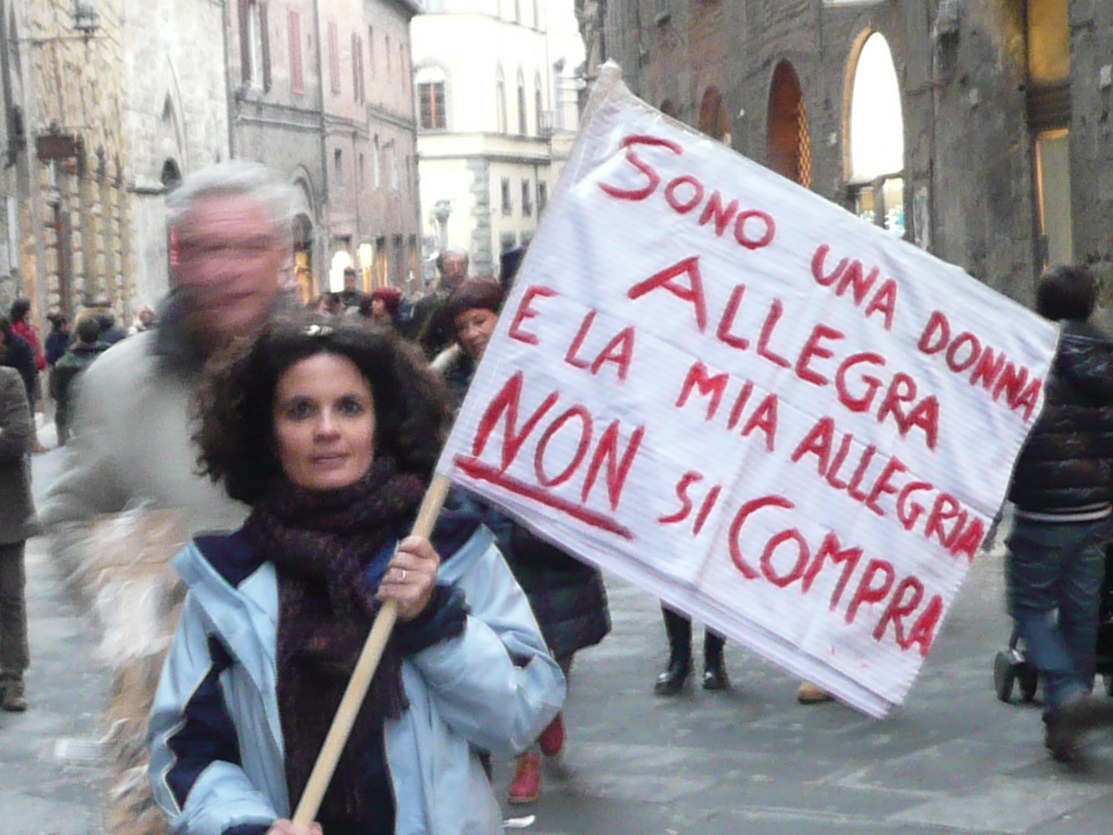


So it was encouraging to learn that women throughout Italy, and beyond, were organizing a "Giorno della Donne" -- a day of the women -- to demand respect for their dignity, and the resignation of Silvio Berlusconi. Taking a slogan from a book by Italian-Jewish Holocaust survivor, Primo Levi, "Se non ora, quando?" (If not now, when?)
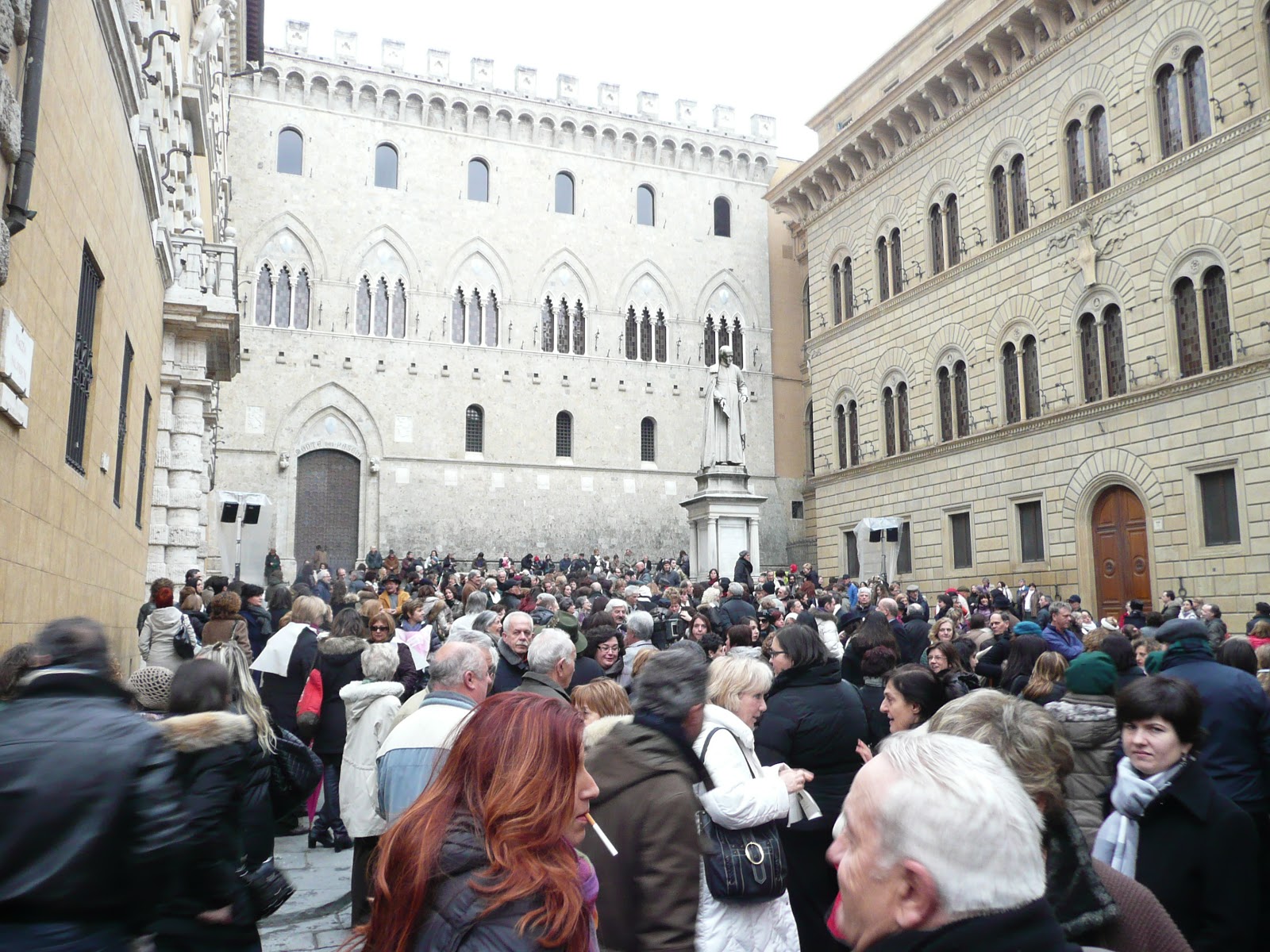 We just happened to be in Siena last Sunday when the manifestazione was scheduled. Ironically, I suppose, the demonstration was held in the beautiful Piazza Salimbeni, under the watchful eye of Archdeacon Sallustio Bandini, and in front of the Banca Monte dei Paschi di Siena, the oldest bank in the world (1474) AND the place where Berlusconi kept a special account to compensate Ruby and the bunga bunga girls.
Saturday, January 9, 2010
La Festa dell'Epifania


This year we were lucky to arrive in Italy early enough to enjoy the celebration of the Feast of the Epiphany commemorating the visit of the three Iranian astrologers (i Magi) to the baby Jesus. In Perugia, the celebration included a children’s party honoring La Befana, a costumed procession through the historic center of Perugia, and a free concert by a local community orchestra. La Befana is an old crone who, it is reputed, visits children on the eve of the Epiphany (5 January) to leave gifts of candy for “good” children and coal for misbehaved kids. The legend of Befana, which is an Italian original, is that the Magi stopped at her hut to ask directions to Bethlehem to visit the newborn king. Befana, always busy with sweeping and baking, could not help them, but after they had left she regrets that she hadn’t joined them. So she packs her bag with goodies and her broom and sets out to find il Bambino. (Part of the legend is that she had lost her only child and looks for the newborn to alleviate her grief.) She never does find him, and so she continues her quest to this day, visiting homes wherever there are children and leaving gifts and sweeping the floor. Interestingly, a Perugian street sweeper had attached a Befana doll to his little 3-wheeled Piaggio – no doubt a tribute to the patroness of sweepers. See the pictures. The procession portraying the Magi assembled in the Piazza d’Italia and I was able to get a photo of a double-humped camel – the real star of the parade -- and his handler.
We brought you peace!
As they proceeded down the Corso Vannucci, I took a video showing the Magi and other fantastic characters, including a black prince sitting high atop the camel looking impossibly dignified. As if all this weren’t amazing enough, the musicians played – of all things – an Israeli folk song “Havenu shalom aleichem” (We brought you peace).
Amazing Chops!
After the procession, there was a free concert, in the beautiful Sala dei Notari (the old City Council chamber in the 13th Century Palazzo dei Priori) by a local community orchestra, La Filarmonica Pretola, with a surprisingly eclectic selection of tunes ranging from Harold Arlen to Giuseppe Verdi. The band – all wind instruments plus percussion -- played well enough, but for me the highlight was the improvising lead trumpeter in "Over the Rainbow" (Sopra il Arcobaleno) who had amazing chops despite his advanced years – see the video.
Postscript: They're all here, safe, sound, and well-fed!
 (Above Kara, Abby, Evan and Amie following a hearty cena of gnocchi and pollo.)
Tuesday, January 5, 2010
Returning to Perugia
Waiting for gli studenti
The Franciscan Heritage Semester Study Abroad Program (FHP) 2010 is scheduled to resume in a few days with the arrival of our intrepid cohort of St. Bonaventure students: Evan Comins, Amie Marasco, Kara Telfer, Abby Schaaf and Ryan O’Donnell. Kara and Abby are education
 majors who are taking advantage of the special opportunities that FHP offers. They will be taking courses that have been approved for education majors, including Developmental Psychology, language and Clare College courses. In addition, Kara and Abby will be interning at the Perugia Montesorri school. Evan and Amie will be completing a series of courses that will virtually complete the requirements for an International Business minor. Their course schedule will include several business courses that focus on European and global business practices, including the politics and economics of the European Union, and, of course, they will study Italian. Their semester will be topped off by a month long internship with the Costa D’Oro Olive Oil Company in nearby Spoleto. And Ryan is enrolled in the “full immersion” Italian language and culture program. This is a unique program in which students attend Perugia’s Universita per Stranieri (University for Foreigners) studying Italian while their progress is monitored by the Umbra Institute, which awards credits transferable to American universities.
(Above: That's Mrs. C on Corso Vanucci, still decorated for Christmas. Right below: Ryan enjoys the first of many pizzas at the Cafe di Perugia.)

Ryan is already here (his program starts a few days earlier) and the other students will arrive soon. I thought that this might be a good time to resume blogging. Before the program starts in earnest I thought it would be a good opportunity to update our activities since last year.
Last summer, Mrs. C and I visited three of our AFCU (Association of Franciscan Colleges and Universities) partner campuses, Hilbert College, Neumann University and Felician College, greeting old friends and making some new ones for the program. We are looking forward to their participation, hopefully for spring, 2011. We’ll be attending the AFCU Symposium this summer at USF Fort Wayne, IN, and will encourage wider participation by AFCU schools. To date, we have enrolled students from Alvernia, Neumann, USF Ft. Wayne, Marian, as well as SBU.
Spring 2009 highlights


(From left

 to right: Senora Traub waiting for the bus to Todi;
Mrs. C leads Umbra Seder; Gerry Straub leads Assisi retreat; clockwise: Gilberto Zapitello, Tim Noone, Judy C., Colleen Noone climbing Mt. Subasio; Jacques Dalarun overlooking the Spoleto Valley, Mt. Subasio and Assisi.)
To review some of the highlights of last year’s program: We were happy to host, Dr. Maria Traub, of Neumann University, whose course, “Saints and Relics” integrated field trips to the sites of saints whose relics are found throughout Italy, with many Franciscan saints in Umbria. In January, we welcomed the internationally renowned Franciscan scholar, Jacque Dalarun, who gave a fascinating presentation illustrating his paleographic and interpretive skills on the famous autograph letter of Francis to Leo (which we were later to view in the Duomo in Spoleto.) Later in the semester, we hosted a Passover Seder, led by Mrs. C, and attended by students of various faiths. We organized a lenten retreat at Casa Papa Giovanni, in Assisi, lead by the well-known Franciscan film maker Gerry Straub, and attended by Tim Noone (yes, another famous scholar) and his wife, Colleen, and the Italian philosopher Gilberto Zapitello. Of course, we also took students on field trips to Assisi, Montecasale, and La Verna in conjunction with my course on “Contemporary Global Issues: The Franciscan World View.” We look forward to resuming many of these special events, and an expanded range of courses and visitors with more students participating in 2011.
Mrs. C’s famous melanzane parmigiana
Back in the US this fall, we sponsored the visit of Tom Cornell of the Catholic Worker Movement, P
 ax Christi, and the Catholic Peace Fellowship Tom is credited with organizing the very first anti-Viet Nam war demonstration in 1963, and the first corporate act of resistance to the Viet Nam War, the burning of draft cards, in 1965. (See picture on the left from NYTimes, 1965.) We first met Tom in Assisi in March, 2008, where
  he led a conference on the issue of conscientious objector status for Catholic GIs. He was returning from an audience with Pope Benedict regarding the CO question, and was accompanied by a former Abu Ghraib interrogator, Joshua Casteel, who had recently won a CO discharge as a Catholic pacifist. While at SBU, Tom visited several classes, lectured to the University Forum, and visited the Olean cabin where Thomas Merton summered with Robert Lax. (See photo on the right for Tom in Lax's cabin.)
Finally, no update would be complete if I didn’t mention the visit to SBU of several of my
 students from the previous spring: Nikki Tarantula and Ashlee Serik, from Neumann, and Patrick Craven from Elon U. They were visiting their Bonaventure friends Phil Penepent and Noel Baylor. Patrick also had a more "serious" purpose: he had decided to write his senior thesis on "Franciscan Theology of Creation and Community Supported Agriculture," and so I was happy to bring him to Mt. Irenaeus and Canticle Farm to interview Franciscan brothers and sisters whose ministries embodied the spirit of Francis and nature. (See photo above of Patrick at Canticle Farm with Sister Joyce Ramage, Farmer Mark Printz, and unnamed dog.)
 Of course, we could not let the leave western New York without a fine dinner of Mrs. C's famous melanzane parmigiana (eggplant parmesan) !!!!
(Above is a picture of -- clockwise -- Ashlee, Nikki, the C's, Phil, Noel and Patrick. Notice the clean plates and the conspicuous bottle of Costa D'oro's Il Grezzo on the table.)
Next: The Magi visit Perugia
Thursday, April 9, 2009
Marzo Pazzo Redux

Gilberto's Town and Bruna's People
We arrive in Imola, a small city best known for its loud Speedway, and are met by Gilberto who brings us to his home in Castel del Rio, the lovely nearly perfect town in Romagna. Tomorrow we are to join "Bruna's people" on a field trip to a restored Benedictine monastery in Cesena,
and on to Forli for an exhibition of the sculpture of Canova. The trip was organized by the Universita' per Adulti di Lugo, where Gilberto teaches and Bruna serves as administrator.
 The monastery, Santa Maria del Monte, was a fascinating combination of architectural periods and styles. But this is unremarkable in Italy. What did catch my attention was largely ignored by the tour: a series of amateurish pictures portraying the intentions of people in distress who were granted favors in response to vows (voti) made to Santa Maria.
The pictures portrayed astonishing scenes: a concentration camp, several car accidents with a victims on the side of the road, families with empty tables, and a scene of


aerial bombardment. In each of these was a small figure of the statue of the saint and sometimes a text, either of petition, thanks, or to ask for help in fulfilling the vow.
Of course, as in all things Italian, we all sat for a fantastic pranzo. (But I must confess that I could not get past a small taste of "trippa.")
H o r s e b a t h P r a n z o

In the Romagnolo countryside there is a district known Rossetta, and a smaller portion known as Bagnocavallo, which means literally "horsebath" and here Bruna treated us to anall day pranzo in an ancient stone farmhouse, surrounded by husband Giovanne's orchards of peach and plum in full blossom. Inside the fireplace and wood cookstove were blazing, while friends and family arrived, ate, and departed and arrived, ate and departed again.

I think the pictures tell the story of that magical
wonderful day with beautiful people, great food,
and lovely surroundings. Topped by a spectacular Romagnolo sunset.

Subscribe to:
Posts (Atom)